
By: Ntugho Luiz Agho President of Association of Private and Mission Teachers in Cameroon
As a proponent of peace, I believe that peace does not simply mean the absence of conflict. Peace can truly endure only when justice is realized and the dignity of every individual is respected. Therefore, when discussing peace, human rights and due process must also be addressed.
A democratic society is not judged solely by how it punishes crime. Another vital standard is how it treats individuals before a final court judgment is rendered. In particular, whether the rights of the elderly and the socially vulnerable are sufficiently protected serves as an important measure of a society’s maturity. The presumption of innocence is not a privilege reserved for specific individuals, but a fundamental principle meant for all citizens.
As the leader of the Association of Private and Mission School Teachers of Cameroon (ASSOPAMTICAM), I have long been interested in spreading peace through education. Driven by this commitment, I had the opportunity to participate in the peace education programs conducted by Heavenly Culture, World Peace, Restoration of Light (HWPL).
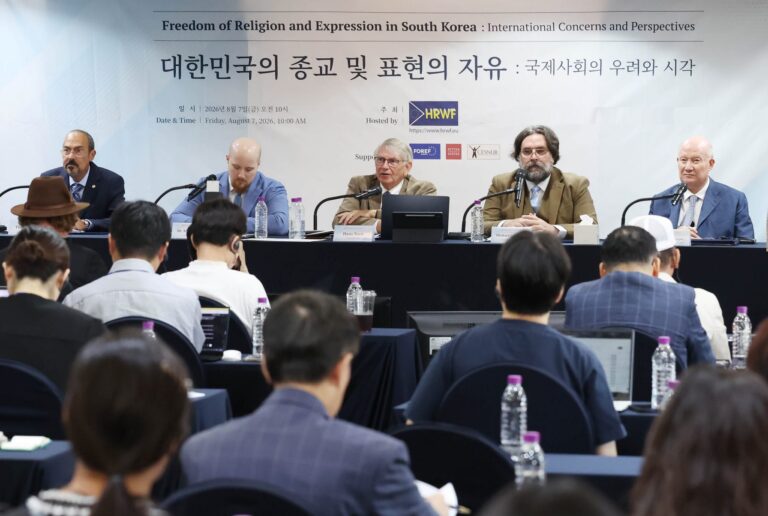
Through this education, I observed firsthand the potential of peace education to impart values of respect, responsibility, and peaceful conflict resolution to students. Furthermore, I came to believe that education should not stop at teaching these values to students, but must also lead society to practice them. It is for this reason that I wish to express my concerns from a humanitarian perspective regarding the ongoing detention investigation of Chairman Lee Man-hee of HWPL.
I fully respect the judicial procedures and the rule of law in the Republic of Korea. Whether a law has been violated must be determined by the court in accordance with evidence and due process, and that entire procedure should be respected. This statement is by no means intended to influence the outcome of the trial or to challenge the authority of the judiciary.
However, detention during investigation is one of the most severe measures by which the state can restrict an individual’s freedom before guilt or innocence is legally established. For this reason, international human rights standards emphasize that detention should be applied exceptionally only when strictly necessary, with full consideration given to its necessity and proportionality.
Chairman Lee Man-hee, in particular, is an elderly person of 95 years of age. In such cases, humanitarian considerations taking into account health and physical conditions need to be reviewed as well. The strict enforcement of the law and compassion for human beings are not conflicting values, but principles that can be pursued together.
Legal scholars and human rights experts around the world have also noted that while respecting judicial procedures, appropriate humanitarian considerations are required for the elderly and vulnerable groups. This does not mean pre-judging the court’s decision, but highlighting the principle that everyone deserves respect even within legal proceedings.
As an educator, I teach my students that justice must be applied fairly to everyone and that the dignity of every person must be respected. These values should be practiced not only within schools, but also across society as a whole.
I hope that the judicial authorities of the Republic of Korea, while respecting the law and due process, will also extend sufficient humanitarian consideration to this matter. Doing so will not weaken the rule of law, but will demonstrate a society where justice and respect for humanity are realized together.
This matter is not merely about a single individual. It can serve as an opportunity for us to reflect on how our society protects an individual’s fundamental rights and dignity during the law enforcement process. Peace becomes all the more solid when justice and human rights are respected together. I hope that education will pass these values on to the next generation, thereby helping to build a more just and peaceful society.